Getting people to visit your website or landing page is one thing but getting them to take action is another. Whether you want them to buy a product, sign up for a newsletter, or fill out a form, the magnitude of your success lies in your conversion rate.
A strong conversion rate means your marketing efforts are working great, while a weak one suggests you’re losing potential customers along the way. But don’t worry; understanding and optimising your conversion rate can turn things around.
In this guide, we’ll break down what conversion rate is, why it matters, and how you can calculate and improve it for better business results.
What is Conversion Rate?
Conversion rate is the percentage of the total visitors or users who complete a desired action on your website, app, or marketing campaign.
This action could be making a purchase, signing up for a newsletter, filling out a form, downloading an eBook, or even clicking a specific link.
A high conversion rate indicates that your audience finds your content, product, or offer valuable enough to take action.
On the other hand, a low conversion rate suggests that your website, ad, or landing page might need optimization.
Why is Conversion Rate Important?
Understanding and optimising your conversion rate is important for several reasons:
- Better ROI (Return on Investment): If you’re running ads or other marketing campaigns, increasing your conversion rate means getting more results without increasing your budget.
- Improved User Experience: A high conversion rate often indicates that your website is easy to navigate and your offer is compelling.
- Business Growth: More conversions mean more leads, sales, or sign-ups, which translates to higher revenue.
- Efficient Marketing Strategies: Measuring conversion rates helps you identify which marketing strategies work best and where you should invest more effort.
How to Calculate Conversion Rate
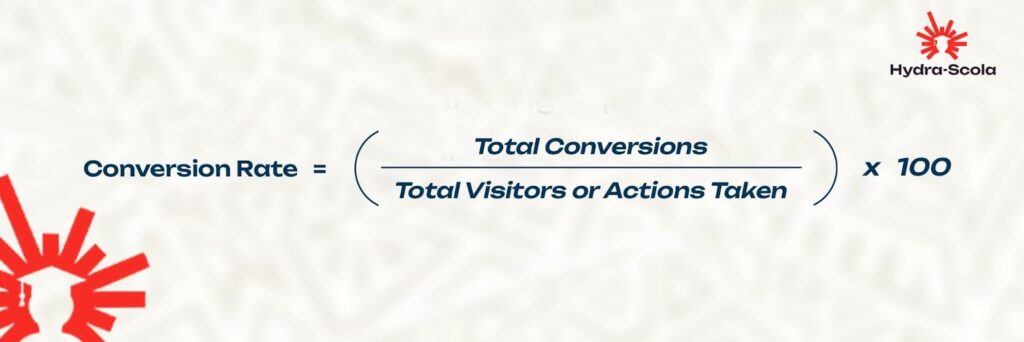
The conversion rate formula is simple:
Conversion Rate=Total ConversionsTotal Visitors or Actions Taken100
For example, if 500 people visit your website and 50 of them make a purchase, your conversion rate would be:
50500100=10%
Conversion Rate Calculation in Different Scenarios
Conversion rates are not restricted to a specific business. Rather, the conversion rate formula can be applied to different situations.
Here’s a breakdown of how that works:
| Scenario | Action Considered a Conversion | Visitors/Leads | Conversions | Conversion Rate (%) |
| E-commerce Store | Completed purchase | 10,000 | 500 | 5% |
| SaaS Business | Free trial sign-up | 5,000 | 250 | 5% |
| Blog | Newsletter signup | 2,000 | 200 | 10% |
| Landing Page | Form submission | 1,500 | 150 | 10% |
Factors That Affect Conversion Rate
Like every other key marketing metric, your conversion rate is influenced by several factors.
Here are some of the key ones to consider:
1. Website Design & User Experience
A poorly designed website with slow loading times and cluttered pages can drive your visitors away.
A well-structured, fast, and mobile-friendly website, on the other hand, encourages users to take action.
2. Call-to-Action (CTA) Effectiveness
Use clear, direct, and persuasive CTAs.
Try phrases like “Get Started Now” or “Claim Your Discount” rather than vague CTAs like “Click Here.”
3. Audience Targeting
If you’re targeting the wrong audience, your conversion rate will suffer.
Therefore, ensure your marketing efforts reach people who are genuinely interested in your product or service.
READ ALSO: 5 Signs You’re Targeting the Wrong Audience (And How to Fix It)
4. Pricing and Offers
Competitive pricing, discounts, and limited-time offers can also help to increase conversions. If your pricing isn’t competitive, visitors might leave without converting.
5. Trust Signals and Social Proof
People are more likely to convert if they trust your brand. So show testimonials, case studies, security badges, and customer reviews to build credibility.
Conversion Rate Optimisation (CRO) Strategies
Boosting your conversion rate isn’t a one-and-done thing. It takes continuous testing and fine-tuning.
Here are some tested and trusted strategies to help you get better results:
1. A/B Testing
Test different versions of your landing page, CTA buttons, and headlines to see what drives the most conversions.
2. Improve Page Load Speed
A slow website can hurt conversions. Optimise images, use caching, and invest in better hosting.
3. Mobile Optimisation
Since a large number of users browse on mobile devices, ensure your site is mobile-friendly.
4. Clear and Compelling CTAs
Your CTA should stand out and be action-driven. Use contrasting colours and clear messaging.
5. Simplify Forms
If you require users to fill out a form, only ask for essential information. Long forms can discourage users from converting.
6. Use High-Quality Visuals and Videos
Images and videos can help explain your product or service better, making it easier for visitors to make a decision. Making it high quality improves response.
7. Offer Money-Back Guarantees
Reducing risk encourages more people to take action. A money-back guarantee can help to eliminate hesitation.
Case Study: How a Business Increased Its Conversion Rate by 50%
Company: XYZ E-commerce Store
Challenge: Low conversion rate of 3% on their product pages.
Solution:
- Implemented a clearer CTA: Changed “Buy Now” to “Get Yours Today—Limited Stock!”
- Improved mobile responsiveness.
- Added customer reviews and testimonials.
- A/B tested different product images.
Results: After three months, their conversion rate increased from 3% to 4.5%, leading to a 50% increase in sales.
How to Track and Measure Conversion Rate
You can use the following tools to track and measure conversion rates:
- Google Analytics: Tracks website conversions and user behaviour.
- Facebook Pixel: Monitors conversions from Facebook and Instagram ads.
- Heatmaps (Hotjar, Crazy Egg): Helps understand where users are clicking and what elements may need improvement.
- A/B Testing Tools (Optimizely, VWO): Allows you to test variations of your pages.
- CRM & Email Marketing Tools (HubSpot, Mailchimp): Tracks email campaign conversions.
Common Conversion Rate Benchmarks by Industry
Wondering how your conversion rate compares to industry standards? Here’s an overview:
| Industry | Average Conversion Rate (%) |
| E-commerce | 2.5% – 3.5% |
| SaaS | 4% – 7% |
| Lead Generation | 5% – 10% |
| Finance & Insurance | 5% – 10% |
| B2B | 2% – 5% |
If your conversion rate is lower than industry standards, it’s a sign that your strategy needs improvement.
Final Thoughts
Understanding and optimising your conversion rate can lead to better sales, engagement, and overall business success.
Whether you run an e-commerce store, a SaaS business, or a blog, continuously refining your strategy and testing what works best will help you maximize your conversions and derive more value from your marketing efforts.

Elsie Udoh is a writer who transformed her love for talking into a career. You can easily tell that she talks a lot by how her paragraphs flow.
She’s big on clarity, connection, and helping people learn something new without getting bored halfway through.