So, you finally sent that pitch after days of research and fine-tuning your proposal. You hit ‘send’ and brace yourself for a response. Days pass, and your inbox remains stubbornly empty.

Then, just when you’re about to give up, a reply pops up! But instead of the enthusiastic ‘yes’ you were hoping for, it’s the dreaded “We’ll get back to you soon.”
If you’ve been in this situation, you know that “soon” often means “never.” And if you keep hearing more ‘maybes’ than ‘yeses,’ it can feel very draining.
However, in my experience, a ‘maybe’ isn’t actually a dead end or an outright rejection. Instead, it’s an opportunity.
And with the right approach, you can flip the table and effectively handle client objections, turning maybes into solid yeses. I’ll show you just how you can do that here.
Why Clients Say ‘Maybe’
Some clients can feel downright impossible to convince and close. You provide all the proof they ask for, yet their response remains the same: “Let me think about it.” Let’s admit, it is frustrating, right?
But then, here’s the thing: no client is truly impossible.
People follow predictable patterns, and once you understand why they hesitate, you gain the power to steer their decision in your favour.
Here are some common reasons why clients hold back:
1. Unclear Value Proposition
Humans are naturally self-centred. We’re wired to prioritise what benefits us.
So if a potential client doesn’t instantly see the value in your offer, they won’t feel compelled to commit.
They might like your pitch, but if they can’t connect it to a clear, personal benefit, they’ll hesitate, or worse, walk away.
Therefore, it’s your job to make the value you provide so clear that saying yes becomes the only logical choice.
2. Budget Concerns
Another common reason why clients hesitate is due to pricing.
They may think your services are too expensive or that they can get a cheaper alternative elsewhere.
3. Lack of Urgency
If there’s no compelling reason to act now, clients will delay their decision. They might be interested but feel no pressure to move forward.
4. Trust Issues
Some clients hesitate because they don’t fully trust your ability to deliver. This could be due to a lack of social proof, testimonials, or case studies.
5. Decision Fatigue
Clients may be juggling multiple options and struggling to decide. This could cause them to stall instead of making a decision.
How to Successfully Turn a ‘Maybe’ Into a ‘Yes’
Now that you’ve unlocked the first step to handling client objections—understanding why they hesitate—it’s time to take things up a notch.
Let’s discuss strategies that will help you turn that hesitant maybe into a confident yes.
1. Address Their Concerns Head-On
Every delay can be dangerous when discussing with a potential client. Instead of passively waiting for them to make a decision, be proactive.
Most times, a potential client won’t openly express their concerns unless prompted, so it’s up to you to dig deeper.
Ask them questions like, “Is there anything preventing you from moving forward?” This will help you pinpoint the exact reason behind their hesitation, whether it’s budget concerns, uncertainty about value, or fear of making the wrong choice.
Once they share their concerns, acknowledge them and provide a helpful response. If it’s about cost, tell them about the return on investment they’ll get from the purchase. Or flip it, and talk about the revenue they are missing out on by not fixing that problem.
If they’re unsure about your expertise, share testimonials or case studies.
The earlier you do this, the faster you eliminate doubts and make it easier for them to say yes.
2. Show Them Social Proof
Another thing you can do is showcase social proof. This includes testimonials, success stories, and case studies.
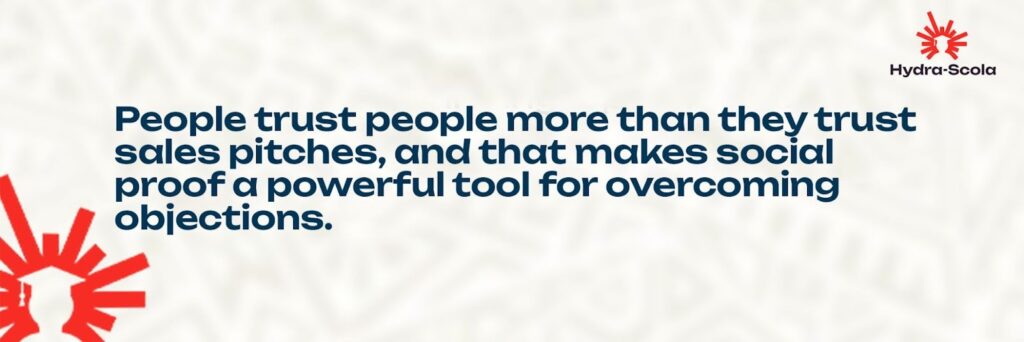
People trust people more than they trust sales pitches, and that makes social proof a powerful tool for overcoming objections.
When a potential client sees others who have benefitted from your service, it reassures them that they’re making a smart decision.
Ensure that your social proof is not vague; instead, share detailed testimonials that show real results, showcase case studies that break down the problem and solution, and use before-and-after success stories to create an emotional connection.
If possible, you can go beyond generic praise and include specifics like measurable improvements, time saved, or revenue growth.
These tangible proofs will make it easier for hesitant clients to trust you and confidently say yes.
3. Create a Sense of Urgency
Many people hesitate simply because they don’t feel pressured to make an immediate decision. You can change that by adding incentives that make waiting seem like a missed opportunity.
This will compel them to act now rather than later.
Here’s how you can create a sense of urgency:
- Use limited-time offers to create scarcity
You could tell them, “This special rate is only available until Friday.”
- Offer exclusive bonuses that add extra value
Say something like, “Sign up today and get a free strategy session.”
- Highlight the potential loss for delaying
You could also say, “Every day you wait is another day you’re missing out on increased sales.”
When clients feel like waiting could cost them something valuable, they’re far more likely to make a decision and say yes.
4. Offer Flexible Solutions
If budget is the main issue, don’t let it be a dealbreaker. You can offer flexible solutions that make saying yes easier. How?
Give clients options to reduce the financial pressure and build trust.
For example, you could set up a payment plan that allows them to pay in smaller, manageable installments.
You could also provide a scaled-down version of your service that fits into their budget and still provides value.
Or highlight the long-term return on investment, showing them how your service will eventually pay for itself.
Sometimes, all your client needs is reassurance that they’re making a financially sound decision. When you remove the risk and make affordability a non-issue, they’re much more likely to commit.
5. Follow Up Strategically
Many deals slip away simply because of lack of proper follow-up.
Don’t expect your clients to constantly remember you; they could get busy and genuinely forget to get back to you. It’s up to you to give them a gentle reminder.

Instead of waiting in silence, take the initiative with a friendly and strategic check-in.
A well-timed follow-up keeps you on their radar and shows that you’re interested in helping them. Keep your follow-up message casual yet professional, something like this:
“Hey [Name], I just wanted to follow up on our conversation. I’d love to help you with [the problem], and the solution I shared with you can make things a lot easier and smoother for you. Let me know if you’re ready to move forward or if you have any questions.”
If you don’t get a response, don’t assume they’re not interested. A second or third follow-up, perhaps with additional value, such as a testimonial or a limited-time offer, can be the nudge that turns their hesitation into action.
Conclusion: Turning Hesitation Into Action
The next time a client tells you ‘maybe’ or “I’ll think about it,” they don’t always mean ‘no’. They are simply telling you to convince them.
And if you read this article until this point, then you’re well-equipped with the strategies you can use to guide them toward making the right decision—your offer.
Now, go ahead, study and apply these suggestions, and turn those ‘maybes’ into ‘yeses’.
Want More Valuable Sales and Marketing Tips? Check Out These Articles on the Hydra-Scola Blog
The Art of the Sales Call: How to Confidently Close More Clients
10 Low-Cost Marketing Tactics for Small Business Owners
5 Signs You’re Targeting the Wrong Audience (And How to Fix It)
5 Easy Sales Follow-Up Strategies That Increase Client Conversions by 50%

Elsie Udoh is a writer who transformed her love for talking into a career. You can easily tell that she talks a lot by how her paragraphs flow.
She’s big on clarity, connection, and helping people learn something new without getting bored halfway through.